

Most UAE hotels treat whatsapp automation for hotels as a feature checklist: pre-arrival messages here, a chatbot there, review requests at the end. Wrong frame.
Shipped in the right order, the same stack pays back inside the first week. Shipped in the wrong order, or without the UAE compliance layer wired in from day one, it stalls in month six or draws AED 150,000 fines from the regulator.
Key Takeaways
- WhatsApp is the highest-leverage guest channel switch — WhatsApp messages reach around a 98% open rate versus roughly 20% for hotel email, and UAE guest behaviour already skews toward WhatsApp as the primary contact channel.
- Ship pre-arrival confirmations before anything else — Transactional messages tied to a booking carry the lowest compliance friction and produce revenue in week one; one property reported a 20% increase in spa bookings after moving upsells to WhatsApp.
- Broadcast messaging requires TDRA approval or steep fines — Cabinet Resolutions 56 and 57 of 2024, effective 27 August 2024, require TDRA prior approval, a locally registered number, and a Do Not Call Registry scrub before any WhatsApp broadcast; DNCR breaches run AED 50,000, AED 75,000, then AED 150,000 per offence.
- Arabic and English must work from day one — UAE guests write in Arabic, English, and Arabizi within the same conversation, so intent detection and routing need both languages built in from the start, not translated in afterward.
- Build the stack in phases, not all at once — Phase one covers pre-arrival and in-stay flows through the PMS and a shared inbox; phase two adds review and CRM integration; phase three brings in reactivation campaigns once the compliance workflow is routine.
Why UAE Hotels Should Automate WhatsApp Before Any Other Channel
The queue math is uneven. WhatsApp messages reach around a 98% open rate; hotel email campaigns fight for roughly 20%. In the UAE, WhatsApp is already the primary way guests contact your property, so tuning email while WhatsApp threads sit unread is the wrong queue to optimise.
Around 61% of clients now prefer to communicate over WhatsApp and social platforms, and UAE guest behaviour skews harder in that direction than most global markets. Guests message and expect a reply in minutes, not hours.
Treat what follows as a stack, not a menu. There is a build order and it matters. Skip ahead and you inherit the compliance risk without the revenue coverage to justify it.
In Abu Dhabi the equivalent regulator is the Department of Health, and its licensing conditions differ from Dubai's in the detail.
Layer One: Pre-Arrival Confirmations and the Check-In Window
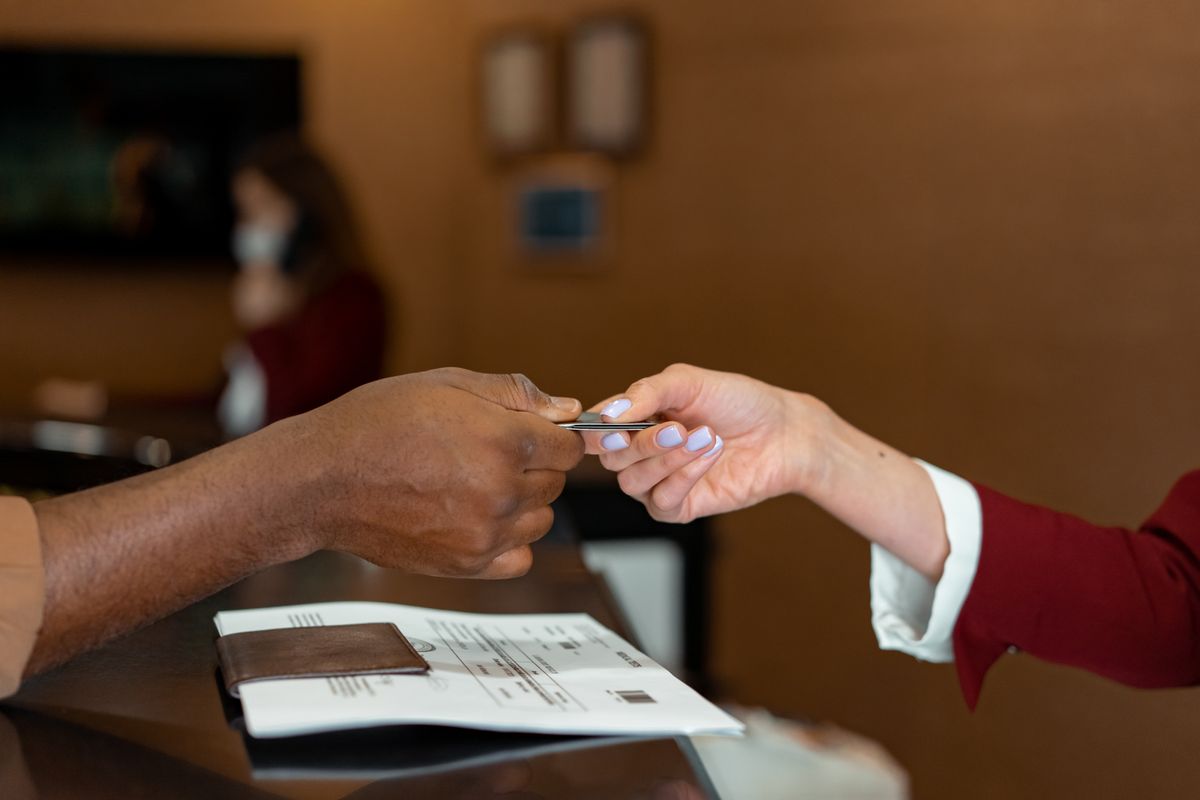
Photo: Mikhail Nilov on Pexels
Pre-arrival is the safest first shipment for whatsapp automation for hotels. Booking confirmations and check-in details triggered from your PMS reach guests at exactly the right moment with zero staff effort, and transactional templates carry the lowest compliance friction under UAE rules.
This window is also the cleanest upsell in the guest lifecycle. Room upgrades, spa slots, dinner reservations, and airport transfers land in front of someone who has already committed to arriving. One property reported a 20% increase in spa bookings after moving these offers to WhatsApp.
The plumbing is simple: your PMS fires the trigger, an approved WhatsApp Business Solution Provider delivers the template, and the guest replies in the same thread. No app to download.
Ship this layer first because revenue shows up in week one and operational risk is close to zero.
Layer Two: In-Stay Requests, Complaint Routing, and Mid-Stay Upsells
This layer is about throughput. Once guests are on property they message constantly: towels, restaurant hours, spa availability, a broken kettle. Automated triage means the routine questions resolve in seconds while your staff handle what actually needs a human.
Well-configured AI can handle around 85% of enquiries automatically, and chatbot automation reportedly saves up to 80% of the time staff spend on repetitive tasks. That reclaimed capacity is the point. Automation should expand what a good front-desk team can deliver, not replace the people who built the hotel's reputation.
Complaint routing is where design quality shows. A guest complaining about noise at 2 a.m. should reach the duty manager in seconds, not the marketing intern in the morning.
UAE guests write in Arabic, English, and Arabizi, sometimes all three in one thread. A routing layer that only parses English breaks for a material share of your guest base at the first touchpoint.
Layer Three: Post-Stay Review Requests and Reactivation Campaigns
Once transactional and in-stay flows are stable, post-stay is where WhatsApp starts driving repeat revenue. Review requests sent within an automated window after checkout reportedly hit around 95% open rates at properties running them, versus email sitting near 20%.
Personalise each request with the guest's name and stay details, keep it short, and offer a one-tap link to Google. That is the entire mechanic.
Reactivation is the second half of this layer, and it is where most hotels leave the most money on the table. Every property is sitting on a dormant guest list: check-outs from six, twelve, twenty-four months ago who never came back.
One point before you touch reactivation: it is a broadcast use case, which means UAE telemarketing law applies. That is the next section.
Lined up together, the three layers show why the build order tracks both compliance exposure and payback speed.
| Layer | What Ships | Build Phase | Headline Result |
|---|---|---|---|
| Layer One – Pre-Arrival | Booking confirmations, check-in details, upsells | Phase one | 20% increase in spa bookings |
| Layer Two – In-Stay | Request handling, complaint routing | Phase one | AI handles around 85% of enquiries automatically |
| Layer Three – Post-Stay | Review requests, reactivation campaigns | Phases two and three | Review requests hit around 95% open rates |
UAE Compliance: What Cabinet Resolutions 56 and 57 of 2024 Require Before You Send a Broadcast

Photo: cottonbro studio on Pexels
Before any WhatsApp broadcast campaign, you need TDRA prior approval, a locally registered number, and a scrub of your recipient list against the Do Not Call Registry. Cabinet Resolutions 56 and 57 of 2024, effective 27 August 2024, made these mandatory for anything that qualifies as marketing.
The fines are not trivial. Per the UAE legislation portal, a first DNCR breach costs AED 50,000, a second AED 75,000, and a third AED 150,000.
These are per-breach figures, so a single unwiped campaign can trip several at once. Most hospitality tech vendors will not surface this before you sign, so ask.
Federal Decree-Law No. 45 of 2021, the UAE's Personal Data Protection Law, governs how you store and use guest contact details in the first place. Consent has to be captured at a defined moment in the booking flow, before any marketing message goes out, and the record has to stay auditable.
Hotels inside DIFC or ADGM face layered data regimes on top of federal PDPL; treat that as a separate conversation with your data protection officer.
Bilingual Automation: Why Arabic and English Must Both Work from Day One
Bilingual is a structural requirement in the UAE, not a translation task you bolt on later. Guests write in Arabic, English, and Arabizi in the same conversation, and a flow that only handles English fails at the first message for a material share of your audience.
Built right, bilingual whatsapp automation for hotels means intent detection, routing logic, and response generation all working across both languages simultaneously. Translating a finished English flow into Arabic after the fact never produces the same experience, because the underlying decision tree was designed around English phrasing.
Language detection at the first message is the pivot. If the automation mistriggers and answers Arabic in English, or vice versa, the guest now has to repeat themselves to a human. That is a worse experience than no automation at all.
Lenoo AI builds bilingual by default, and for UAE hotels we treat this as a non-negotiable design constraint. Do not accept a vendor who ships Arabic as a phase-two deliverable.
Connecting the Stack: What to Link, What to Keep Human, and How to Phase the Build
Phase one connects three systems: your PMS for event triggers, the WhatsApp Business API through an approved Business Solution Provider, and a shared front-desk inbox where staff can pick up escalations. Those three integrations make the pre-arrival and in-stay layers operational.
Phase two adds a review platform and a CRM for post-stay flows. Phase three brings in your marketing stack for reactivation campaigns, and by then your compliance workflow (TDRA approval, DNCR scrubbing, consent records) needs to be a routine step in every send, not a scramble before each one.
Keep humans in the loop for escalated complaints, VIP requests, and any commitment your automation cannot safely make. Over 90% of guests reportedly read messages sent through an integrated WhatsApp chatbot, which is what makes the investment pay back, but reading a message and getting the right answer are different problems.
Ship in phases and measure at each one. The property that tries to build all three layers before the first go-live usually never goes live.
If you want a shortcut, book a free 30-minute consultation. No pitch.
We will map which whatsapp automation for hotels layer fits your property first, tell you what to skip, and hand back a plan with cost and timeline. If it does not make business sense, we will say so.
Related reading
- AI Appointment Booking
- AI Lead Qualification for Business Setup Companies
- Never Chase a Bad Lead Again
- AI by industry
FAQ
Do UAE hotels need TDRA approval before running WhatsApp broadcast marketing campaigns?
Yes. Under Cabinet Resolutions 56 and 57 of 2024, effective 27 August 2024, any marketing broadcast requires TDRA prior approval and a locally registered number. Transactional messages tied to a specific booking (confirmations, check-in details) sit outside that scope, but promotional campaigns to a list do not.
What fines can a UAE hotel face for messaging guests on the Do Not Call Registry?
Per the UAE legislation portal, DNCR breach fines run to AED 50,000 for a first offence, AED 75,000 for a second, and AED 150,000 for a third. Scrubbing your recipient list against the registry before every send is the only reliable way to stay clear.
Which whatsapp automation for hotels should a UAE property build first?
Pre-arrival confirmations and check-in messages triggered from your PMS. They carry the lowest compliance friction, ship in days, and produce revenue in week one through upsells like spa slots and room upgrades. In-stay routing comes second; broadcast reactivation campaigns come last, once your compliance workflow is stable.
What is the difference between WhatsApp Business and the WhatsApp Business API?
WhatsApp Business is the free app for small teams managing conversations on one phone. The WhatsApp Business API supports automation, PMS triggers, multi-user inboxes, and campaign templates, and it is what hotels need for anything beyond a handful of manual replies. You access it through an approved Business Solution Provider.
How does a hotel manage guests who message in Arabic, English, or a mix of both?
Your automation needs language detection at the first message and separate intent and response models for each language, working together in one flow. If a guest switches mid-thread or mixes Arabizi with Arabic, the flow has to keep up or hand off cleanly to a bilingual staff member.


